
IT Roadmap 2026-2029 for law firms: how to plan infrastructure, cybersecurity and AI in 6 steps
Summary
- The digital evolution of the Italian law firm
- Step 1: audit of existing infrastructure and gap analysis
- Step 2: Migration to Secure Cloud (Hybrid or Full Cloud)
- Step 3: Reinforce Cybersecurity and Align with Regulations
- Step 4: ethical and secure adoption of Artificial Intelligence
- Step 5: Staff Continuous Training (IT Training)
- Step 6: Defining Support SLAs and Proactive Monitoring
- Conclusion and personalized assessment
- FAQ on the IT Roadmap for Law Firms
- How long does it take to implement a three-year IT Roadmap?
- How often should staff training be updated?
- How does the cloud reconcile with privacy and attorney-client privilege?
- What is the advantage of having an ISO 27001 certified IT partner?
- Is the artificial intelligence integrated into the firm secure?
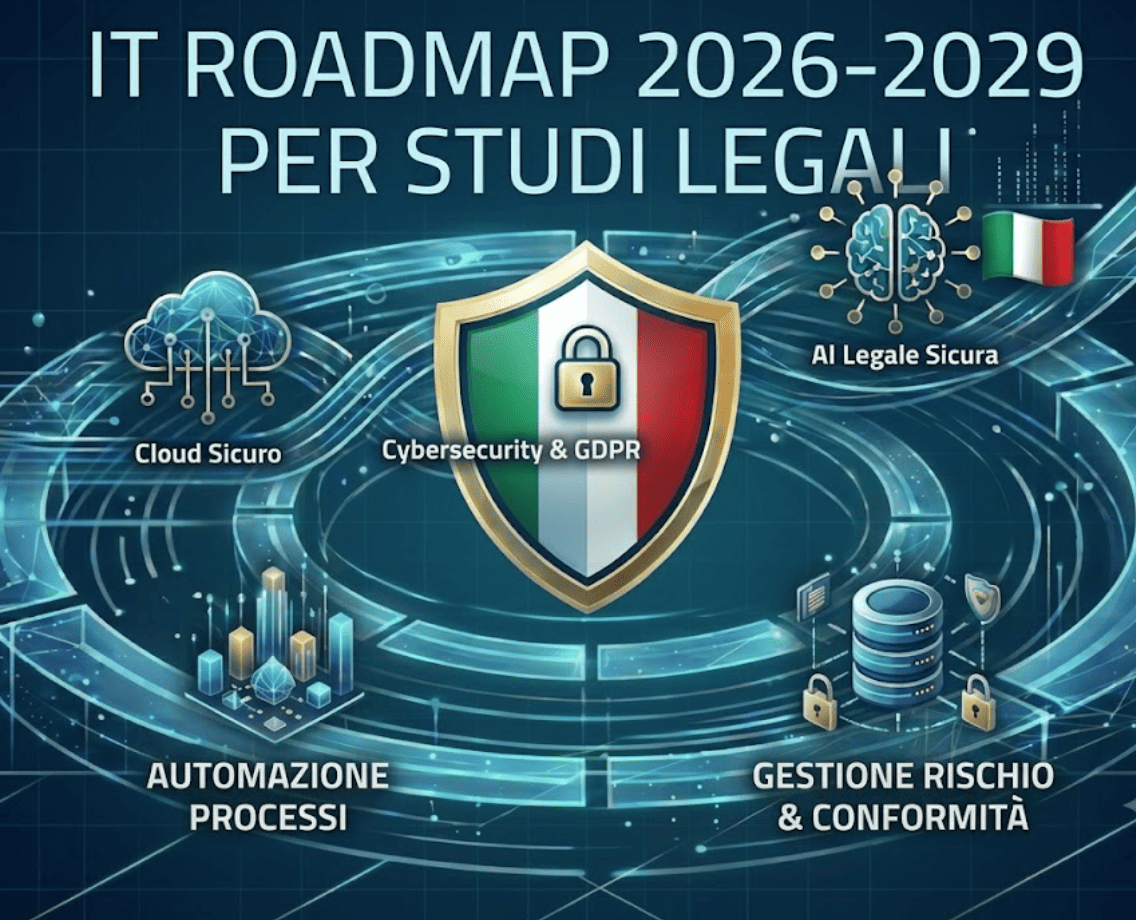
Technological evolution is redefining the operational boundaries of law and notary firms in Italy. The massive adoption of artificial intelligence, the transition to the cloud, and the exponential increase in cyber threats require associated firms to move from reactive IT management (based on intervention after a failure) to strategic three-year planning. A structured IT Roadmap 2026-2029 represents the fundamental tool to ensure the operational continuity of the firm, protect the confidentiality of client data in compliance with GDPR, and integrate AI ethically and securely. In this article, we analyze the 6-step methodological path developed by Lanpartners to guide partners and IT managers in the infrastructural and security planning of the modern law firm.
The digital evolution of the Italian law firm
Law and professional firms naturally manage an informational asset of inestimable value: trade secrets, corporate financial data, sensitive private information, and documents protected by professional privilege. Until a few years ago, the protection of this asset relied on local servers physically housed within the firm (on-premise) and simple perimeter firewalls.
Today, the scenario has completely changed. The widespread smart working of professionals, the use of mobile devices to access procedural documents on the go, and interconnection with ministerial telematic platforms (such as the Lawyer Console and Electronic Civil Proceedings ) have dissolved the traditional security perimeter of the studio.
Planning a three-year technology roadmap for the 2026-2029 period is no longer an optional choice reserved only for large international business firms, but a vital necessity also for legal boutiques and medium-sized associated firms that want to maintain competitiveness in the market, reduce fixed costs, and eliminate the risks of sanctions for data breaches.
Step 1: audit of existing infrastructure and gap analysis
The first step in structuring any strategic planning is to analytically assess the studio's technological state of the art. Too often, partners decide to purchase new software or hardware on the spur of the moment or out of emergency, without understanding if the basic infrastructure is capable of supporting them.
The initial audit must analyze:
- Network connectivity: Internet line bandwidth and redundancy (essential if the studio works entirely in the cloud).
- System obsolescence: the age of local servers, PCs, and Macs provided to professionals and secretarial staff.
- The Document Management System (DMS): how files are stored, cataloged, and searched. For a more in-depth look at market-leading systems, we refer you to our analysis on Technologies Integrate.
- License Status: the compliance of operating systems and productivity suites (for example, the transition to Microsoft 365).
The resulting gap analysis will highlight critical bottlenecks and risks (e.g., unsupported operating systems exposing the practice to known vulnerabilities) that must be addressed in the first phase of the roadmap.
Step 2: Migration to Secure Cloud (Hybrid or Full Cloud)
Maintaining physical servers in the studio incurs high costs for maintenance, electricity for air conditioning, and constant risks related to theft, fire, or flooding. The IT Roadmap 2026-2029 must include a planned and secure transition to the cloud.
Migration can follow two models:
- Full Cloud suitable for firms that want to completely eliminate local physical infrastructure. Data, email, and management software reside in protected and redundant data centers, securely accessible via encrypted credentials from anywhere.
- Hybrid Cloud: for studios that need to maintain some legacy databases or software locally, while integrating the main workflows (email, current document archiving, collaboration) on secure public clouds such as Microsoft Azure.
Migration does not simply consist of moving files from a local folder to a cloud folder (so-called “lift and shift”), but in reorganizing the firm's document workflows, defining granular access permissions based on departments or individual work teams, ensuring that document sharing externally (e.g., with clients or opposing parties) occurs via secure, temporary, and traceable links, and not via unprotected email attachments.
Step 3: Reinforce Cybersecurity and Align with Regulations
Cybersecurity represents the central pillar of an IT roadmap. In recent years, law firms have become one of the preferred targets for cybercrime: ransomware attacks (data encryption with ransom demands) and phishing scams (credential theft) can paralyze a firm for days or weeks.
It should also be added that regulatory compliance can no longer be postponed, especially for practices assisting companies in critical sectors impacted by NIS 2 Directive , where supply chain security (supplier chain, including legal consultants) becomes a stringent requirement.
Priority actions to include in the security planning are:
1. Multi-factor authentication (MFA): This should be made mandatory for every single account in the firm (email, management software, VPN). It reduces the risk of unauthorized access due to stolen passwords by 99%.
2. EDR + MDR Systems (Endpoint Detection and Response): Compared to old static antivirus systems, EDR systems monitor the behavior of PCs and Macs in real time. However, EDR technology alone generates alerts that, without human analysis, risk becoming mere background noise. For this reason, the model to be integrated into the roadmap involves pairing EDR with a service MDR (Managed Detection and Response ) managed by a specialized team that monitors 24/7, filters false positives, and intervenes promptly in the event of a real attack.
3. Zero Trust Policies: no device or user should be considered secure a priori, even if physically located within the practice's network. Every access must be continuously authenticated and verified.
Furthermore, the firm must align with international security standards. In this regard, you can consult the details on our ISO 27001 certification and our range of services cybersecurity dedicated.
Step 4: ethical and secure adoption of Artificial Intelligence
Generative artificial intelligence offers extraordinary opportunities for lawyers: rapid drafting of legal documents, summarization of complex contracts, and accelerated jurisprudential research. However, improper use of public and free AI tools (such as basic versions of ChatGPT or Copilot) exposes the firm to very serious legal risks of violating professional secrecy and GDPR, as data entered into prompts can be used to train public models.
To integrate artificial intelligence securely, the firm should follow a protocol based on these principles:
- Use of vertical and closed AI: the firm must exclusively adopt AI platforms dedicated to the legal world, such as the well-known Harvey or the widespread Legora and Lybra solutions, where data remains confined within the firm's tenant. Among these, Lanpartners recommends Lexroom as the main technology partner for its accuracy and maximum security guarantees within the Italian context.
- Integration into the work environment: tools such as legal AI integrated into Microsoft 365 allow secure querying of one's internal document databases without data loss.
- Transparency and oversight: AI must be used as an assistant (copilot) and never as a substitute for the professional. Every document generated or synthesized by AI must undergo critical review and final approval by a lawyer (human-in-the-loop).
Step 5: Staff Continuous Training (IT Training)
The most advanced technology is completely ineffective if the people using it are not trained or do not follow safety procedures. Over 90% of successful cyber attacks start with human error (clicking on a phishing link or downloading a suspicious attachment).
The three-year roadmap must include periodic technological training plans:
- Security awareness courses Training for secretarial staff and professionals on current cybersecurity risks, how to recognize sophisticated phishing emails, and how to securely manage passwords.
- Periodic attack simulations: controlled tests in which simulated phishing emails are sent to measure the firm's level of awareness and identify individuals who require further training.
- Training on the use of document management systems: sessions to ensure everyone uses the DMS and cloud according to the practice's guidelines, avoiding the storage of sensitive files on local desktops or personal USB drives.
Step 6: Defining Support SLAs and Proactive Monitoring
Proper IT planning doesn't just involve implementing new technologies, but must define how they will be managed and supported over time. A law firm cannot afford long operational downtimes: if the Lawyer's Console doesn't work on the deadline for filing a document, the damage to the client and the firm can be incalculable.
The roadmap must include the transition to support contracts based on clear and stringent SLAs (Service Level Agreements):
- Guaranteed response times: resolution of critical issues within a few hours (SLA < 4 hours).
- Proactive Monitoring (RMM) the studio's infrastructure must be monitored 24/7 remotely using proactive monitoring software. This allows anomalies (such as nearly full disks or missing updates) to be identified and resolved before they turn into system blocks for users.
- Tested Disaster Recovery Plans: clear and written procedures for the complete restoration of the firm's operations in case of disaster (e.g., hardware failure or malware infection), with periodic testing of backup restoration to verify the integrity of saved data.
Conclusion and personalized assessment
Planning the IT Roadmap 2026-2029 means investing in the law firm's stability, security, and future growth. It's not about doing everything at once, but about logically distributing investments over 36 months, first eliminating critical vulnerabilities and then implementing efficiency technologies (such as AI and advanced cloud management systems).
Every day without a structured roadmap is a day your firm remains exposed to avoidable risks. The right time to start is now.
Don't know where to start? In 60 minutes we help you build the foundations for your firm's IT priority map for the next three years. Book your free IT Roadmap session.
FAQ on the IT Roadmap for Law Firms
How long does it take to implement a three-year IT Roadmap?
The IT Roadmap is a long-term plan divided into phases. The initial phase of auditing and securing urgent systems usually requires 1-2 months. The complete migration to the cloud and the integration of complex AI and management systems are distributed over the following months (phases 2 and 3) based on the firm's budget and staff availability, minimizing the impact on daily productivity.
How often should staff training be updated?
Cybersecurity training is not a one-time event, but a continuous process. Lanpartners recommends security awareness sessions at least twice a year, supplemented by quarterly phishing simulations to maintain a high level of attention from all studio personnel.
How does the cloud reconcile with privacy and attorney-client privilege?
The cloud used for law firms must comply with strict European compliance standards (GDPR). Data resides in data centers located within the European Union, protected by encryption both in transit and at rest (256-bit encryption). Lanpartners configures access only through secure protocols with MFA authentication, ensuring the firm maintains exclusive control over encryption keys.
What is the advantage of having an ISO 27001 certified IT partner?
ISO 27001 certification attests that the IT provider adopts an Information Security Management System that is structured and monitored by independent third-party certification bodies. For a law firm, this translates into the assurance that the partner managing their operating systems and client data operates in compliance with the highest global standards for physical, logical, and organizational security.
Is the artificial intelligence integrated into the firm secure?
Yes, provided that professional AI solutions with dedicated licenses and isolated tenants are used, where the data entered is not shared externally in any way or used to train public OpenAI or Microsoft models. Lanpartners configures secure AI environments (such as Microsoft Copilot B2B, Harvey, Legora, Lybra, or Lexroom) to protect the confidentiality of your firm's information.
